Showing posts with label Book Review. Show all posts

Friday, February 17, 2017

The Wild Edge of Sorrow ...


There is some strange intimacy between grief and aliveness, some sacred exchange between what seems unbearable
and what is most exquisitely alive. Through this,
I have come to have a lasting faith in grief.

Francis Weller
The Wild Edge of Sorrow


Hello, Everyone,

I began the post below earlier last month but was interrupted and forgot to hit the "publish" button so here it is now, sans the snow! .....

Here in Vancouver, we are trapped in the wilds of winter with more snow on the ground, in the trees, on the roads and in the air in this past week than we usually see in a year! The whole world seems to be held in muted abeyance, hibernating as it waits for its natural rhythms to return. It's a time to bury yourself in a cozy blanket with a good book and that's just what I've been doing all weekend.

Having lost four dear ones since mid-December (five, if we count my sister's Maggie-dog, a lovely Bernese Mountain Dog who captured all our hearts), witnessed the devastation of so many  lovely trees at the lake during this year's unusual snowfalls, been stunned by the deaths of six innocent Muslims at prayer in Quebec City and experienced profound sorrow at the hateful rhetoric arising from so many parts of our world, I have been reading a new-to-me book on grief. I'd like to share some of its goodness with you this morning.

Francis Weller's book, entitled The Wild Edge of Sorrow: Rituals of Renewal and the Sacred Work of Grief, is one of the better volumes on grief I've had the pleasure to read. Beautifully written, it covers five categories of loss which Weller says form five gateways to grief

1.  The gateway of illness and death
2.  The gateway of the parts of our selves that didn't receive love -  parts that were then lost  through being wrapped in shame, banished and marked unworthy
3.  The gateway of the world's sorrows -  the loss of care for the earth and the devastated state of the earth and its creatures 
4.  The gateway of what we expected and did not receive -  the loss of the welcome, engagement, touch and reflection we are all hardwired to expect at birth and throughout our lives but may not have received because we weren't raised by a village that could meet multiple needs or because
5.  The gateway of ancestral grief - the losses of our ancestors, often unknown or unacknowledged, and the secondary losses arising from the ways in which they coped with their pain (violence, alcoholism, eating disorders, emotional abuse and neglect, rejection of culture etc), all still carried within our bodies

Weller spends a good deal of time talking about the importance of ritual, a form of support readily available to the bereaved but often missing for people with disenfranchised grief such as chronic sorrow. Because this grief response is not mentioned specifically in the book, the volume also lacks the needed cautions reminding family caregivers to avoid doing deep grief work around more than one loss at one time so as not to become overwhelmed.

I found this book a poetic read with exquisitely evocative language. It provides a needed reminder for all of us to acknowledge and work with our losses so they don't have a continuing negative impact on our selves and our world and so that our personal aliveness can be kindled through the transformation of our grief. Weller's writing is empathic and resonates with the grief of the reader and, although its  recommended group work for healing grief is not a process that appeals to my introverted soul, it obviously appeals to and helps many others. I would recommend this book to anyone interested in learning more about ritual and the healing of grief.

A second book I've found supportive and soothing in these days of sadness is Jan Richardson's new book, The Cure for Sorrow: A Book of Blessings for Times of Grief. While written from the specific perspective of a United Methodist minister and new widow in the US, this book touches on universal themes of loss, grief and transformation and invites us to "know the tenacity of hope and to recognize the presence of love which ... is 'sorrow's most lasting cure'". Here is one of Jan's new blessings, one which I think applies to caregivers as much as to the bereaved:


The Blessing You Should Not Tell Me

Do not tell me
there will be a blessing
in the breaking,
that it will ever
be a grace
to wake into this life
so altered,
this world
so without.

Do not tell me
of the blessing
that will come
in absence.

Do not tell me
that what does not
kill me
will make me strong
or that God will not
send me more than I
can bear.

Do not tell me
this will make me
more compassionate,
more loving,
more holy.

Do not tell me
this will make me
more grateful for what
I had.

Do not tell me
I was lucky.

Do not even tell me
there will be a blessing.

Give me instead
the blessing
of breathing with me.

Give me instead
the blessing of sitting with me
when you cannot think
of what to say.

Give me instead
the blessing
of asking about him -
how we met
or what I loved most about the life
we have shared;
ask for a story
or tell me one
because a story is, finally,
the only place on earth
he lives now.

If you could know
what grace lives
in such a blessing,
you would never cease
to offer it.

If you could glimpse
the solace and sweetness
that abide there,
you would never wonder
if there was a blessing
you could give
that would be better
than this -
the blessing of your own heart
opened and beating
with mine.


Blessings to all of you who grieve today.


Saturday, November 29, 2014

My Favourite Comfort Books ...

Hello, everyone!

My apologies for the hiatus in posting. It's been a particularly busy month with workshops and talks interspersed with treatment for my recently diagnosed normal-tension glaucoma. I'd forgotten, (with the same kind of denial a mom uses to "forget" the pain of labour so she can do it again), how time-consuming specialists' visits, tests and treatments for chronic conditions can be. While I have some vision loss in one eye, my pressures have stabilized, I've managed to avoid surgery and I have time, once again, to enjoy writing some holiday posts (and perhaps, some new workshops for 2015).

Reading has always been one of my favourite comfort activities so I thought I'd share with you a list of my favourite "comfort books" for your own reading pleasure and, perhaps, for holiday gift-giving:

1.   The Guernsey and Potato Peel Pie Society by Mary Ann Shaffer and Annie Barrows (2009)  I hugged this book when I finished reading it for the first time in 2009 and I've read it at least twice since. Set in 1946 and beyond, the story is revealed through a series of letters between an author, Juliet Ashton, who is searching for ideas for her next book and members of the Guernsey Literary Society. Fascinated by the people she is meeting through the letters, Juliet decides to go to Guernsey to meet her new friends. This book describes both life in WW II, German-occupied Guernsey and the invincible spirit, humour  and honour of the people who lived through those times.
2.  The Two of Us: My Life With John Thaw by Sheila Hancock (2004) This wonderful biography/autobiography of British actor, John Thaw, (Morse, Kavanaugh QC, Goodnight, Mr Tom) by his wife, Sheila, (also a well known British actor) provided me with unceasing comfort and the affirmation that I wasn't losing my mind through the early years following my husband's death and I still pick it up from time to time ten years later. It, in concert with its sequel, Just Me, is the best book on spousal grief I've read. Interspersed with stories of their early lives are moving, emotionally honest, italicized segments from Sheila's journals, tracing John's diagnosis with cancer, Sheila's caregiving and her early struggles with bereavement. A sometimes painful but ultimately heartwarming story of strength, hope and deep spousal love.
3.  Listening Below the Noise: A Meditation on the Practice of Silence by Anne LeClaire  (2009)  This eloquent little book sits on my bedside table and I dip into it from time to time just to enjoy the beauty of the writing, let alone the wisdom of the words. Anne LeClaire, a novelist and journalist, shocked her husband, children and friends by deciding to spend every 1st and 3rd Monday in silence. To say that it disrupted the pattern of their lives is an understatement and there was plenty of pushback. But eventually, they  began to learn what she was learning - that in silence lies joy and a much deeper connection with oneself, with others and with Nature.
4.  Kitchen Table Wisdom: Stories That Heal by Rachel Naomi Remen, MD  (1996/2006) My husband read this wonderful storybook before I did and couldn't resist interrupting what I was doing to read lengthy excerpts out loud. Rachel Remen, a physician, medical educator and patient with a severe chronic illness, writes stories of hope, humour and joy that remind us that even the worst circumstances can bring us experiences of mystery and growth. These stories were a source of comfort and healing as I recovered from my second bout of compassion fatigue.
5.  To Bless the Space Between Us: A Book of Blessings by John O'Donohue (2008) I love this book of blessings and have quoted it often in my workshops and in this blog. John O'Donohue describes a blessing as a circle of light drawn around a person to strengthen, heal and protect. His blessings, steeped in Celtic spirituality, offer comfort and encouragement in situations as varied as beginnings, desires, thresholds, homecomings, states of the heart, callings and endings. 
6.  Enchanted April by Elizabeth von Arnim (1922/2014) This is a gentle story of four very different women from 1920's London who travel to Italy to escape loneliness, sorrow, dreariness and the dissatisfaction of exploitative and overbearing relationships. Once away from the unending winter and greyness of their lives in England, they settle into the sunny warmth, simplicity and undemanding rhythms of a country guesthouse and slowly begin to come to life. I love the book and the British movie by the same name and return to both again and again.
7.  Winter Solstice by Rosamunde Pilcher  (2000) Written in Rosamund Pilcher's warm and evocative style, this story of later-life love, loss and healing weaves through difficulties and tragedy to a thoroughly satisfying Christmas ending in a rambling house in Northern Scotland. If you're looking for an easy and predictable but heartwarming read to help you transition to the spirit of the holiday season, this is it.
8.  Why I Wake Early: New Poems by Mary Oliver (2004) Anything by Mary Oliver is comfort reading for me. I especially like this volume which includes poems on crickets, toads, trout, lilies, goldenrod, bears, greeting the morning, watching the deer and lingering in happiness. Reading Mary Oliver is like going for a silent walk through woods and meadows with a very dear friend - absolutely perfect.
9.  Girl of the Limberlost by Gene Stratton-Porter (1909) I first read this inspiring book when I was about ten or twelve years old. It tells the story of Elnora Comstock, an impoverished girl living in the Limberlost who, despite her father's tragic death and her mother's strict and bitter parenting, manages to "lift herself above her station", excel at school and become a gifted violinist. Any time I feel discouraged about life, I go back and reread the story of this spunky young woman who overcame so much to find the happiness she sought.  
10.  Christmas With Rosamunde Pilcher by Rosamunde Pilcher  (1997)  I'm not sure why I love this book so much but every year I bring it down from the bookshelf on the last Sunday in November to mark the beginning of the holiday season. I settle in front of the fire with a glass of eggnog and with Marty Hagen's Night of Silence playing on the stereo and carefully turn the shiny smooth pages taking in exquisite photos of winter in Scotland and of the Pilcher family preparing for and enjoying their family Christmas. Then I snuggle more deeply into the chair to read from the last third of the book, a lesser-known Pilcher short story, Miss Cameron's Christmas. This gentle tale of family caregiver, Miss Cameron, and of the kindness of neighbours at Christmas time never fails to lift my heart and to begin the season on exactly the right note.

So, these are ten of my favourite comfort books. What about you? Are there stories you might like to re-read yourself or to give friends, children or grandchildren as a gift of comfort this holiday season?


Thursday, October 2, 2014

A New Book for Your Fall Reading:


Hi Everyone!

I'm just back from a walk at the lake where I could see my breath for the first time this fall and where I wished I had thought to bring along a pair of gloves! As I walked in the early morning light, I was thinking about compassion fatigue and chronic sorrow resilience and how important basic information is to our ability to heal and come back from the secondary trauma and accumulated grief of our helping work.

In the early 1980's, complex trauma author, Jane Middelton-Moz, called basic information about trauma and grief healing, a cognitive life raft. A cognitive life raft is an intellectual understanding of the healing process that acts as a secure base when the experience, itself, feels overwhelming. It reminds us that our feelings and responses are natural and understandable within the context of our experience.

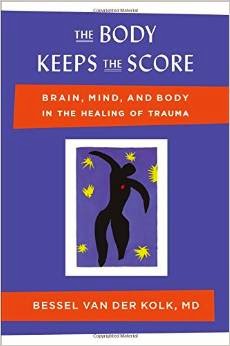
This week, an excellent book by Boston-based psychiatrist and trauma expert, Bessel van der Kolk, became available, adding a new source of information for building our cognitive life rafts. The book is called,  The Body Keeps the Score: Brain, Mind and Body in the Healing of Trauma. I'm about half way through it and couldn't wait to let you know how good it is.

Reading like a novel, this well-reviewed book (the "Advance Praise" pages read like a Who's Who of the trauma and mindfulness worlds) covers Dr van der Kolk's evolution in understanding of trauma over 30 years as a clinician and researcher. It explores the world of trauma healing under headings such as:

1.  The Rediscovery of Trauma
2.  This is Your Brain on Trauma
3.  The Minds of Children
4.   The Imprint of Trauma
5.   Paths to Recovery
The chapter on recovery includes sections on trauma language, the legacy of inescapable shock, EMDR, trauma-sensitive yoga, self-regulation, rewiring the brain, finding your voice through theatre, and making choices about trauma treatment as a society. There is an emphasis on the individual nature of treatment - one size does not fit all and psychopharmacology, in particular, should only be an adjunct to a larger individualized recovery plan.

This book is a great starting place for trauma survivors, their families and support systems. It offers a clear "big picture" of current trauma understanding and treatment practices in language that is utterly accessible and pleasurable to read. It is a great synthesis of history, research, neuroscience and story, written in the voice of a true story-teller. It begins like this:

The Tuesday after the Fourth of July weekend, 1978, was my first day as a staff psychiatrist at the boston Veterans Administration Clinic. As I was hanging a reproduction of my favourite Breughel painting, "The Blind Leading the Blind", on the wall of my new office, I heard a commotion in the reception area down the hall. A moment later a large, disheveled man in a stained three-piece suit, carrying a copy of Soldier of Fortune magazine under his arm, burst through my door. He was so agitated and so clearly hungover that I wondered how I could possibly help this hulking man. I asked him to take a seat, and tell me what I could do for him.
His name was Tom. Ten years earlier he had been in the marines, doing his service in Viet Nam. He had spent the holiday weekend holed up in his downtown Boston law office, drinking and looking at old photographs, rather than his family. He knew from previous years' experience that the noise of fireworks, the heat, and the picnic in his sister's backyard against the backdrop of dense early-summer foliage, all of which reminded him of Viet Nam, would drive him crazy. When he got upset he was afraid to be around his family because he behaved like a monster with his wife and two young boys. The noise of his kids made him so agitated that he would storm out of the house to keep himself from hurting them. Only drinking himself into oblivion or riding his Harley-Davidson at dangerously high speeds helped him to calm down...  
and the last page includes these words:
Trauma constantly confronts us with our fragility and with man's inhumanity to man but also with our extraordinary resilience. I have been able to do this work for so long because it drew me to explore our sources of joy, creativity, meaning and connection - all the things that make life worth living. I can't begin to imagine how I would have coped with what many of my patients have endured, and I see their symptoms as part of their strength - the ways they learned to survive. And despite all their suffering many have gone on to become loving partners and parents, exemplary teachers, nurses, scientists and artists...
... Trauma is now our most urgent public health issue, and we have the knowledge necessary to respond effectively. The choice is ours to act on what we know ... 

Go out and buy or borrow a copy of this book. You won't regret it.
  

Tuesday, December 1, 2009

Book Review: The Housekeeper and the Professor...

I have just finished reading a lovely book called, The Housekeeper and the Professor. It's a wonderful, gentle read for anyone interested in relationships and how they develop, but particularly wonderful for anyone interested in the subtleties of the caregiving relationship.

The story, itself, is that of a Japanese housekeeper and her 10 year old son who care for an aging mathematics professor with a traumatic brain injury. As the result of the injury, the Professor has a short term memory of only 80 minutes, requiring a re-introduction to the Housekeeper every morning as she arrives to do her work.

Behind foreground themes of mathematics and baseball, Yoko Ogawa's spare but beautiful writing explores the caregiving relationship in all it's complexity. Themes of love, loyalty, fierce protectiveness, vulnerability, denial, humanity, respect, perseverance, and caring are all dealt with in a lean and sometimes poetic hand. We are drawn into the chronic sorrow that is a part of all permanent injuries, the joys and difficulties of life's simplest things, and the day-to- day creativity required for adjusting to lost abilities.

If you are someone who requires action and excitement to make "a good read", this is not the book for you. If, on the other hand, good writing, keen observation and the gift of story telling are the elements of a good book, you will find them here.

Wednesday, October 7, 2009

Book Review: Bounce: Living the Resilient Life...

I'm currently reading Robert J Wicks' new book, Bounce: Living the Resilient Life and am delighted to recommend it to you. (It is so new that the copyright by Oxford University Press is 2010!).

This book, like The Resilient Clinician (2008) and Overcoming Stress in Medical and Nursing Practice (2006), focuses upon transforming stressful situations into opportunities to live a more meaningful, self-aware and compassionate life. It offers principles and techniques of self awareness, stillness, mindfulness, daily debriefing and self care to everyone, not just the professional caregivers for whom Dr Wicks has written for over 30 years.

The table of contents looks like this:


Have a Life!: An Introduction

Navigating Life's Rough Waters: Riding the Crest of Chronic and Acute Stress

Personal Renewal: Creating and Tailoring Your Own Self-Care Protocol

A Powerful Healing Combination: Friendship, Resilience & Compassion

The First Steps Toward Self-Knowledge: Debriefing Yourself

Solitude, Silence & Mindfulness: Centering Yourself In a Driven World

The Simple Care of a Hopeful Heart: An Epilogue


And if that's not enough inducement to find a copy, it is short, well written, easy-to-read and, more than anything, useful, practical and profoundly compassionate. As the friend who recommended Bounce to me said, one reads this book and feels known and understood.

Currently a professor at Loyola University in Maryland, Dr Wicks is a recognized expert in preventing secondary traumatic stress and has been involved in debriefing relief workers from the Rwandan civil war and health care professionals caring for multiple trauma survivors from the war in Iraq.

Enjoy!