Showing posts with label Posttraumatic stress. Show all posts

Friday, January 8, 2016

Paramedic and Family Caregiver "First Responder" Stories


Many of our first responders will be diagnosed with PTSD during their careers, and will battle mood disorders, substance abuse, and suicidal thoughts as a result.

These are kids who live on borrowed time and would test anybody's resilience.

                                                     
Hi Everyone!

While making my monthly stop at CBC Radio's, White Coat, Black Art, I've just come across two programs that are well worth your listening time. The quotes above are from the series host, Dr Brian Goldman, MD.

1.  The first program, Sock Drawer Stories: Portraits of Hope and Healing, describes the posttraumatic stress of emergency paramedics, one in particular who learned to deal with her PTS symptoms through painting. Teresa Coulter paints powerful portraits of colleagues with PTS, "opening their hearts and her's to healing". 

Teresa uses the analogy of a sock drawer (similar to the "file folder in your chest" you've heard me speak about in workshops) to describe what happens when we take the memory and emotion of each "bad call" or medical emergency or other trauma and stuff it in the back of our sock drawer. This works pretty well in the short term, allowing us to "forget" the trauma and present an "I'm fine!" face to the world. However, as time passes and the drawer fills up, opening it to add one more memory can cause all the old memories and feelings to fly out onto the floor.  This is what happens when we find ourselves "over-reacting" to a situation. It makes our PTS warning signs come out on full display.

In this piece, Teresa and her colleagues are interviewed by Brian Goldman about their PTS experiences and their individual paths to healing. 


2.  The second program, One More Thing Moms' Club, describes the experiences of another group of "first responders", a passionately articulate group of family caregivers in the Ottawa area faced every day with the frontline primary care and advocacy for a child with complex illness. While these Moms discuss the realities of life as they care for their children, much of what they say also applies to those caring for adults with similar conditions.

When I first saw the name of this support group, it occurred to me that it could have more than one meaning. Not only are these parents people who always have "one more thing to do" but they also have " one more thing to ask" of helping professionals exiting the room  because there's always another question, arrangement or issue to stress. I can't think of a more apt name for this group!

The unabridged interview with this amazing group of caregivers is well worth hearing in its longer-than-usual format.  

I hope you can take the time to settle into a big chair with a cuppa and really listen to both of these excellent programs. You'll come away inspired.


Thursday, October 2, 2014

A New Book for Your Fall Reading:


Hi Everyone!

I'm just back from a walk at the lake where I could see my breath for the first time this fall and where I wished I had thought to bring along a pair of gloves! As I walked in the early morning light, I was thinking about compassion fatigue and chronic sorrow resilience and how important basic information is to our ability to heal and come back from the secondary trauma and accumulated grief of our helping work.

In the early 1980's, complex trauma author, Jane Middelton-Moz, called basic information about trauma and grief healing, a cognitive life raft. A cognitive life raft is an intellectual understanding of the healing process that acts as a secure base when the experience, itself, feels overwhelming. It reminds us that our feelings and responses are natural and understandable within the context of our experience.

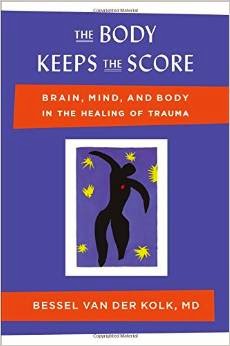
This week, an excellent book by Boston-based psychiatrist and trauma expert, Bessel van der Kolk, became available, adding a new source of information for building our cognitive life rafts. The book is called,  The Body Keeps the Score: Brain, Mind and Body in the Healing of Trauma. I'm about half way through it and couldn't wait to let you know how good it is.

Reading like a novel, this well-reviewed book (the "Advance Praise" pages read like a Who's Who of the trauma and mindfulness worlds) covers Dr van der Kolk's evolution in understanding of trauma over 30 years as a clinician and researcher. It explores the world of trauma healing under headings such as:

1.  The Rediscovery of Trauma
2.  This is Your Brain on Trauma
3.  The Minds of Children
4.   The Imprint of Trauma
5.   Paths to Recovery
The chapter on recovery includes sections on trauma language, the legacy of inescapable shock, EMDR, trauma-sensitive yoga, self-regulation, rewiring the brain, finding your voice through theatre, and making choices about trauma treatment as a society. There is an emphasis on the individual nature of treatment - one size does not fit all and psychopharmacology, in particular, should only be an adjunct to a larger individualized recovery plan.

This book is a great starting place for trauma survivors, their families and support systems. It offers a clear "big picture" of current trauma understanding and treatment practices in language that is utterly accessible and pleasurable to read. It is a great synthesis of history, research, neuroscience and story, written in the voice of a true story-teller. It begins like this:

The Tuesday after the Fourth of July weekend, 1978, was my first day as a staff psychiatrist at the boston Veterans Administration Clinic. As I was hanging a reproduction of my favourite Breughel painting, "The Blind Leading the Blind", on the wall of my new office, I heard a commotion in the reception area down the hall. A moment later a large, disheveled man in a stained three-piece suit, carrying a copy of Soldier of Fortune magazine under his arm, burst through my door. He was so agitated and so clearly hungover that I wondered how I could possibly help this hulking man. I asked him to take a seat, and tell me what I could do for him.
His name was Tom. Ten years earlier he had been in the marines, doing his service in Viet Nam. He had spent the holiday weekend holed up in his downtown Boston law office, drinking and looking at old photographs, rather than his family. He knew from previous years' experience that the noise of fireworks, the heat, and the picnic in his sister's backyard against the backdrop of dense early-summer foliage, all of which reminded him of Viet Nam, would drive him crazy. When he got upset he was afraid to be around his family because he behaved like a monster with his wife and two young boys. The noise of his kids made him so agitated that he would storm out of the house to keep himself from hurting them. Only drinking himself into oblivion or riding his Harley-Davidson at dangerously high speeds helped him to calm down...  
and the last page includes these words:
Trauma constantly confronts us with our fragility and with man's inhumanity to man but also with our extraordinary resilience. I have been able to do this work for so long because it drew me to explore our sources of joy, creativity, meaning and connection - all the things that make life worth living. I can't begin to imagine how I would have coped with what many of my patients have endured, and I see their symptoms as part of their strength - the ways they learned to survive. And despite all their suffering many have gone on to become loving partners and parents, exemplary teachers, nurses, scientists and artists...
... Trauma is now our most urgent public health issue, and we have the knowledge necessary to respond effectively. The choice is ours to act on what we know ... 

Go out and buy or borrow a copy of this book. You won't regret it.