Wednesday, December 24, 2014

Christmas Peace ...


Hello, Everyone,

I've finished the cards, the gift wrapping, the baking and the house-cleaning and I'm now looking forward to a few lovely days of sparkly lights, familiar carols, shared meals and the warm hugs of family and friends.

To each of you, whether anticipating a happy Christmas or one of weariness and stress, I wish a deep sense of peace, the peace that transcends understanding and that is so well described by Goethe in his beautiful poem, Peace:


Peace
There is only silence
On the mountain tops
Among the tips of the trees
You perceive barely a breath
Even the birds in the forest
Keep still and are silent
Wait then
Just a little while longer
And you too
will find peace at last.
                   (JW von Goethe translated by Patrizia Collard) 


May each of us find the peace we seek this holiday season, whether in the quiet of Nature, the beauty of a religious ritual, the arms of a friend or at the bedside of a loved one.

With love and deep peace to you all,

Jan


Thursday, December 18, 2014

Welcoming What Is ...

Hello, everyone,

How are you feeling today?

The winter holidays are times when we can experience a wide range of emotion from excitement, anticipation, hope, pleasure and joy to guilt, loneliness, anger, regret and sorrow. It is our natural human tendency to embrace the joyful feelings and to ignore, push away or brace against the painful ones. Unfortunately, resisting our painful feelings only makes them stronger.

So, what if we made the counter-intuitive decision to stay present to whatever we feel, whatever is, and even to welcome our painful feelings? What if we decided to practice a kind of "inner hospitality", responding to each painful feeling as we would a small child -  noticing it, acknowledging it, welcoming it, letting it be but not letting it overrun the house? Paradoxically, what we might find if we engaged in such a welcoming practice is that the painful feelings would begin to soften or shift of their own accord.

This notion of "welcoming" is found in different forms in many schools of psychology and spirituality. Basically, it comes down to a few simple, though not necessarily easy, steps:

1.  Focus and sink in. Feel the feeling. Don't ignore it, run away from it or fight it. Stay with the experience until you really feel a connection to the physical sensations of the feeling in your body. 
2.  Accept and welcome the feeling. In the midst of your upset, accept and welcome how you feel. Embrace your feeling with love, kindness and warmth. Say, "welcome", to it and experience the welcoming home of this part of yourself.  "Welcome, fear." "Welcome, anger." "Welcome, sorrow." 
Remember that you're not welcoming an event or circumstance but rather your feeling response to it. For example, the welcoming practice is not about welcoming an illness or injury or losing your job or being abused but about welcoming your feelings about those circumstances.
3.  Swing gently and slowly, back and forth between sinking into the experience and welcoming it, until the feeling softens or shifts or, as one writer says, "until the knot begins to dissolve".

This welcoming practice is not about analyzing or justifying our feelings. It's not about trying to change or fix them. It's about be-ing with them and welcoming them home so we can receive their messages and make them part of our wholeness. When we welcome our feelings in this way, we can stay present to ourselves and what is, no matter what our circumstances. And, as we stay present, we will find that even our painful feelings are ultimately transient.

The 13th Century poet, Rumi, seemed to understand this idea of "welcoming what is", into our lives. Here's how he described it in his poem, The Guest House:

This being human is a guest house.
Every morning a new arrival.
A joy, a depression, a meanness,
some momentary awareness comes
as an unexpected visitor.

Welcome and entertain them all!
Even if they are a crowd of sorrows,
who violently sweep your house
empty of its furniture,
still, treat each guest honourably.
He may be clearing you out
for some new delight.

The dark thought, the shame, the malice,
meet them at the door laughing and invite them in.

Be grateful for whatever comes
because each has been sent
as a guide from beyond.


If you would like to know more about the idea of welcoming painful feelings, from a couple of different perspectives, you could read Eugene Gendlin's book, Focusing, or Cynthia Bourgeault's writing on the Welcoming Practice in Centering Prayer.
  
Caveat:  This welcoming practice is probably not the best practice for anyone who is acutely traumatized, actively misusing substances, in early recovery, clinically depressed or with a history of psychosis or difficulty tolerating their own feelings. If you fall within one of these groups, talk to your family physician or therapist before beginning an ongoing welcoming practice.


Saturday, November 29, 2014

My Favourite Comfort Books ...

Hello, everyone!

My apologies for the hiatus in posting. It's been a particularly busy month with workshops and talks interspersed with treatment for my recently diagnosed normal-tension glaucoma. I'd forgotten, (with the same kind of denial a mom uses to "forget" the pain of labour so she can do it again), how time-consuming specialists' visits, tests and treatments for chronic conditions can be. While I have some vision loss in one eye, my pressures have stabilized, I've managed to avoid surgery and I have time, once again, to enjoy writing some holiday posts (and perhaps, some new workshops for 2015).

Reading has always been one of my favourite comfort activities so I thought I'd share with you a list of my favourite "comfort books" for your own reading pleasure and, perhaps, for holiday gift-giving:

1.   The Guernsey and Potato Peel Pie Society by Mary Ann Shaffer and Annie Barrows (2009)  I hugged this book when I finished reading it for the first time in 2009 and I've read it at least twice since. Set in 1946 and beyond, the story is revealed through a series of letters between an author, Juliet Ashton, who is searching for ideas for her next book and members of the Guernsey Literary Society. Fascinated by the people she is meeting through the letters, Juliet decides to go to Guernsey to meet her new friends. This book describes both life in WW II, German-occupied Guernsey and the invincible spirit, humour  and honour of the people who lived through those times.
2.  The Two of Us: My Life With John Thaw by Sheila Hancock (2004) This wonderful biography/autobiography of British actor, John Thaw, (Morse, Kavanaugh QC, Goodnight, Mr Tom) by his wife, Sheila, (also a well known British actor) provided me with unceasing comfort and the affirmation that I wasn't losing my mind through the early years following my husband's death and I still pick it up from time to time ten years later. It, in concert with its sequel, Just Me, is the best book on spousal grief I've read. Interspersed with stories of their early lives are moving, emotionally honest, italicized segments from Sheila's journals, tracing John's diagnosis with cancer, Sheila's caregiving and her early struggles with bereavement. A sometimes painful but ultimately heartwarming story of strength, hope and deep spousal love.
3.  Listening Below the Noise: A Meditation on the Practice of Silence by Anne LeClaire  (2009)  This eloquent little book sits on my bedside table and I dip into it from time to time just to enjoy the beauty of the writing, let alone the wisdom of the words. Anne LeClaire, a novelist and journalist, shocked her husband, children and friends by deciding to spend every 1st and 3rd Monday in silence. To say that it disrupted the pattern of their lives is an understatement and there was plenty of pushback. But eventually, they  began to learn what she was learning - that in silence lies joy and a much deeper connection with oneself, with others and with Nature.
4.  Kitchen Table Wisdom: Stories That Heal by Rachel Naomi Remen, MD  (1996/2006) My husband read this wonderful storybook before I did and couldn't resist interrupting what I was doing to read lengthy excerpts out loud. Rachel Remen, a physician, medical educator and patient with a severe chronic illness, writes stories of hope, humour and joy that remind us that even the worst circumstances can bring us experiences of mystery and growth. These stories were a source of comfort and healing as I recovered from my second bout of compassion fatigue.
5.  To Bless the Space Between Us: A Book of Blessings by John O'Donohue (2008) I love this book of blessings and have quoted it often in my workshops and in this blog. John O'Donohue describes a blessing as a circle of light drawn around a person to strengthen, heal and protect. His blessings, steeped in Celtic spirituality, offer comfort and encouragement in situations as varied as beginnings, desires, thresholds, homecomings, states of the heart, callings and endings. 
6.  Enchanted April by Elizabeth von Arnim (1922/2014) This is a gentle story of four very different women from 1920's London who travel to Italy to escape loneliness, sorrow, dreariness and the dissatisfaction of exploitative and overbearing relationships. Once away from the unending winter and greyness of their lives in England, they settle into the sunny warmth, simplicity and undemanding rhythms of a country guesthouse and slowly begin to come to life. I love the book and the British movie by the same name and return to both again and again.
7.  Winter Solstice by Rosamunde Pilcher  (2000) Written in Rosamund Pilcher's warm and evocative style, this story of later-life love, loss and healing weaves through difficulties and tragedy to a thoroughly satisfying Christmas ending in a rambling house in Northern Scotland. If you're looking for an easy and predictable but heartwarming read to help you transition to the spirit of the holiday season, this is it.
8.  Why I Wake Early: New Poems by Mary Oliver (2004) Anything by Mary Oliver is comfort reading for me. I especially like this volume which includes poems on crickets, toads, trout, lilies, goldenrod, bears, greeting the morning, watching the deer and lingering in happiness. Reading Mary Oliver is like going for a silent walk through woods and meadows with a very dear friend - absolutely perfect.
9.  Girl of the Limberlost by Gene Stratton-Porter (1909) I first read this inspiring book when I was about ten or twelve years old. It tells the story of Elnora Comstock, an impoverished girl living in the Limberlost who, despite her father's tragic death and her mother's strict and bitter parenting, manages to "lift herself above her station", excel at school and become a gifted violinist. Any time I feel discouraged about life, I go back and reread the story of this spunky young woman who overcame so much to find the happiness she sought.  
10.  Christmas With Rosamunde Pilcher by Rosamunde Pilcher  (1997)  I'm not sure why I love this book so much but every year I bring it down from the bookshelf on the last Sunday in November to mark the beginning of the holiday season. I settle in front of the fire with a glass of eggnog and with Marty Hagen's Night of Silence playing on the stereo and carefully turn the shiny smooth pages taking in exquisite photos of winter in Scotland and of the Pilcher family preparing for and enjoying their family Christmas. Then I snuggle more deeply into the chair to read from the last third of the book, a lesser-known Pilcher short story, Miss Cameron's Christmas. This gentle tale of family caregiver, Miss Cameron, and of the kindness of neighbours at Christmas time never fails to lift my heart and to begin the season on exactly the right note.

So, these are ten of my favourite comfort books. What about you? Are there stories you might like to re-read yourself or to give friends, children or grandchildren as a gift of comfort this holiday season?


Thursday, October 30, 2014

Which Wolf Will You Feed? ...


It's been a hard few weeks. Our lives have been shaken by the deaths of 24 year old Canadian Forces Cpl Nathan Cirillo and 53 year old Warrant Officer Patrice Vincent. Many of us have been feeling the effects of secondary traumatic stress as we've been exposed, again and again, to the details of their deaths and the aftermath.

Those of us who know about secondary traumatic stress have tried to respond by focusing on good self care and on gathering with loved ones for comfort or to talk about our thoughts and feelings (though, hopefully, without re-traumatizing each other through the sharing of "gory details"). We've exercised in order to shift some of the trauma energy from our bodies and we've used spiritual practices like meditation and yoga to lower our general level of fight/flight arousal. We may even have tried to teach others to do the same.

But how do we go deeper in our responses, now, now that a little time has passed, the initial shock is wearing off, the funerals and commemorations are done and the families and friends are settling into their long bleak journeys of bereavement? What can we do in our own lives to help prevent such incidents from happening again?

In the months after 9/11, a wisdom story circulated widely that may shed some light on how we can begin to make the changes we would like to see in the world:

A Native American grandfather was speaking to his grandson about violence and cruelty in the world and how it comes about. He said it was as if two wolves were fighting in his heart. One wolf was vengeful and angry, and the other wolf was understanding and kind. The young man asked his grandfather which wolf would win the fight in his heart. And the grandfather answered, "The one that wins will be the one I choose to feed."

And here lies the challenge. Which wolf will we choose to feed as we continue to respond to the events of the past weeks?

Pema Chodron, an American Buddhist teacher living at Gampo Abbey, Cape Breton, reminds us that if we want to see change, we must be the change we want to see in the world. She offers us the following pathway for recognizing how our own words and actions may be causing suffering and leading to aggression and violence. She shows us a simple, though always not easy, way of "feeding the kind wolf":

1.  Make a commitment to ourselves to let go of old grudges, to not avoid people and situations and emotions that make us feel uneasy, to not cling to our fears, our closedmindedness, our hardheartedness, our hesitation. 
 2.  Be honest with ourselves. Most of us have gotten so good at empowering our negativity and insisting on our rightness that the angry wolf gets shinier and shinier, and the other wolf is just there with its pleading eyes. But we're not stuck with this way of being. When we're feeling resentment or any strong emotion, we can recognize that we are getting worked up, and realize that right now we can consciously make the choice to be aggressive or to cool off. It comes down to choosing which wolf we want to feed.
3.  Experiment with interrupting our automatic reactions to the things that push our buttons and make us angry. Learn to pause. Pausing creates a momentary contrast between being completely self-absorbed and being awake and present. We just stop for a few seconds, breathe deeply, become present and move on. Practice this several times every day and then when highly charged situations come along, we can shake up our ancient fear-based habits by simply pausing and waking up. 
4.  Access the 3 basic qualities of being human, natural intelligence, natural warmth and natural openness to help us to feed the kind wolf. When we are angry, when someone says something we don't like, when we want to get even or when we want to vent, we can use our natural intelligence to help us solve problems rather than making them worse,  we can use our natural warmth to love, have empathy, laugh, feel gratitude and appreciation and tenderness, and we can use our natural openness to think expansively, flexibly, curiously and within a stance of pre-prejudice. (Adapted from Pema Chodron)

We can each make a difference in our individual lives and relationships and those individual actions can  add up to make a difference in our society. Each time we choose to feed the kind wolf over the aggressive one, we take one more step toward peace.

If you would like to read more of Pema Chodron's thoughts on choosing new ways of being, try reading her 2009 book, Taking the Leap: Freeing Ourselves from Old Habits and Fears.


Wednesday, October 15, 2014

Memories of Thanksgiving...


If the only prayer you ever say in your entire life is
 thank you,
it will be enough.

Meister Eckart


Happy Thanksgiving, everyone! 

I hope you've had a richly happy holiday weekend no matter where you've been - gathering with loved ones, caring for an ill relative alone at home or working shift at a local hospital or firehall keeping us all healthy and safe.

For me, one of the highlights of Thanksgiving weekend is going to the big Cathedral downtown with family and friends to sing generations-old harvest hymns and see (and smell) the colourful displays of flowers and produce lining the chancel steps. The intentional focus on gratitude, particularly for fruits of the earth to share with others, is grounding and revitalizing. 

This Thanksgiving, theologian, The Rev Dr Ellen Clark-King, drew our attention to how easy it is to become focused on the stresses of life and lose sight of the enormous number of things for which we can be grateful:
When were you last truly thankful? Not just thankful because it was the appropriate social response, not just saying the words with your lips, but feeling that deep gratitude within the centre of your being. When was that? What provoked it? How did it feel? Who did you share it with? What difference did it make to your day or your week or your life? Revisit that feeling, hold it again.
To be honest, I couldn't immediately bring to mind the particular time I'd last felt that grateful. I did get there after a few moments but for someone who writes a gratitude journal most nights, I was surprised at the pause in my remembering. So surprised, in fact, that when I got home, I made a point of pulling out gratitude journals from years past and reminding myself of the particular things for which I'd been whole-heartedly grateful for over the years. The first journal I read was from 1998, the year after my husband, Derrick, was diagnosed with viral cardiomyopathy (progressive weakening of his heart muscle).

Despite watching his diminishing strength and abilities and grieving for the many changes in our lives together, the journal entries of that year reflected the joy of simple things - a slow walk by the lake on a fall morning, a quiet cup of tea together in the mid-afternoon, a short visit with friends, the discussion of a new book. My entries for Thanksgiving Day 1998 included more simple gifts, each one worthy of re-membering:

1.  The beauty of the first frost and the leaves beginning to change
2.  A lovely country Thanksgiving service at little St Oz even though I had to go alone
3.  The feel of Derrick's hand on my face
4.  Derrick feeling strong enough to help with dinner and the fun we had in the kitchen.
5.  Thanksgiving dinner with all of us around the table.  

Being truly grateful is both a spontaneous heart response and a habit of mind. Learning to open ourselves to deep gratitude, intentionally taking in the good of those experiences, and then making time to remember our thankfulness can do much to shape the quality of our lives. For some whose circumstances are painful or exhausting or feeling hopeless, though, it can be hard to imagine such an upsurge in thankfulness as Ellen describes. For you, especially, may the last words of her address hold true:

So hold again that memory of a time when you were truly thankful. Open yourself again to that feeling. Take that with you into this holiday and into the week ahead. Let it live in you and through you, let it touch those around you ... so a thanksgiving day can become a thanksgiving life.


Thursday, October 2, 2014

A New Book for Your Fall Reading:


Hi Everyone!

I'm just back from a walk at the lake where I could see my breath for the first time this fall and where I wished I had thought to bring along a pair of gloves! As I walked in the early morning light, I was thinking about compassion fatigue and chronic sorrow resilience and how important basic information is to our ability to heal and come back from the secondary trauma and accumulated grief of our helping work.

In the early 1980's, complex trauma author, Jane Middelton-Moz, called basic information about trauma and grief healing, a cognitive life raft. A cognitive life raft is an intellectual understanding of the healing process that acts as a secure base when the experience, itself, feels overwhelming. It reminds us that our feelings and responses are natural and understandable within the context of our experience.

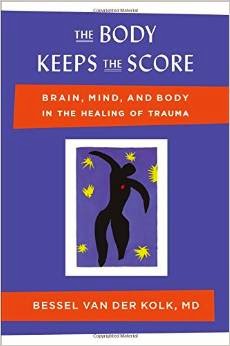
This week, an excellent book by Boston-based psychiatrist and trauma expert, Bessel van der Kolk, became available, adding a new source of information for building our cognitive life rafts. The book is called,  The Body Keeps the Score: Brain, Mind and Body in the Healing of Trauma. I'm about half way through it and couldn't wait to let you know how good it is.

Reading like a novel, this well-reviewed book (the "Advance Praise" pages read like a Who's Who of the trauma and mindfulness worlds) covers Dr van der Kolk's evolution in understanding of trauma over 30 years as a clinician and researcher. It explores the world of trauma healing under headings such as:

1.  The Rediscovery of Trauma
2.  This is Your Brain on Trauma
3.  The Minds of Children
4.   The Imprint of Trauma
5.   Paths to Recovery
The chapter on recovery includes sections on trauma language, the legacy of inescapable shock, EMDR, trauma-sensitive yoga, self-regulation, rewiring the brain, finding your voice through theatre, and making choices about trauma treatment as a society. There is an emphasis on the individual nature of treatment - one size does not fit all and psychopharmacology, in particular, should only be an adjunct to a larger individualized recovery plan.

This book is a great starting place for trauma survivors, their families and support systems. It offers a clear "big picture" of current trauma understanding and treatment practices in language that is utterly accessible and pleasurable to read. It is a great synthesis of history, research, neuroscience and story, written in the voice of a true story-teller. It begins like this:

The Tuesday after the Fourth of July weekend, 1978, was my first day as a staff psychiatrist at the boston Veterans Administration Clinic. As I was hanging a reproduction of my favourite Breughel painting, "The Blind Leading the Blind", on the wall of my new office, I heard a commotion in the reception area down the hall. A moment later a large, disheveled man in a stained three-piece suit, carrying a copy of Soldier of Fortune magazine under his arm, burst through my door. He was so agitated and so clearly hungover that I wondered how I could possibly help this hulking man. I asked him to take a seat, and tell me what I could do for him.
His name was Tom. Ten years earlier he had been in the marines, doing his service in Viet Nam. He had spent the holiday weekend holed up in his downtown Boston law office, drinking and looking at old photographs, rather than his family. He knew from previous years' experience that the noise of fireworks, the heat, and the picnic in his sister's backyard against the backdrop of dense early-summer foliage, all of which reminded him of Viet Nam, would drive him crazy. When he got upset he was afraid to be around his family because he behaved like a monster with his wife and two young boys. The noise of his kids made him so agitated that he would storm out of the house to keep himself from hurting them. Only drinking himself into oblivion or riding his Harley-Davidson at dangerously high speeds helped him to calm down...  
and the last page includes these words:
Trauma constantly confronts us with our fragility and with man's inhumanity to man but also with our extraordinary resilience. I have been able to do this work for so long because it drew me to explore our sources of joy, creativity, meaning and connection - all the things that make life worth living. I can't begin to imagine how I would have coped with what many of my patients have endured, and I see their symptoms as part of their strength - the ways they learned to survive. And despite all their suffering many have gone on to become loving partners and parents, exemplary teachers, nurses, scientists and artists...
... Trauma is now our most urgent public health issue, and we have the knowledge necessary to respond effectively. The choice is ours to act on what we know ... 

Go out and buy or borrow a copy of this book. You won't regret it.
  

Saturday, September 20, 2014

A New Study: Mindfulness for Mothers of Severely Disabled Children ...


Mindfulness is like that - it is a miracle which can call 
back in a flash our dispersed mind and restore it
to wholeness
so that we can live each minute of life.

Thich Nhat Hanh


Are you caring for a child with severe disabilities? Family caregiving can be hard work at the best of times but caregiving for a child or adult child with a severe disability takes an extra toll. Mothers of children with autism or other neurodevelopmental disabilities report high levels of stress, burnout, compassion fatigue, chronic sorrow, depression, and anxiety, all of which can have an impact on your wellness and resilience and on the way you care for your child.

A new study in the journal Pediatrics suggests that both mindfulness and positive psychology techniques can help to reduce your stress. Researcher, Elisabeth Dykens, and her colleagues randomly assigned 243 mothers to a six-week group treatment program employing either mindfulness techniques like deep-belly breathing or to a group using positive psychology exercises focused on building virtues like gratitude and patience. Trained mentors who also had children with disabilities led the weekly hour-and-a-half sessions. The mothers completed mental health assessments before, during and up to six months after the study. 

Before the study, 85% of the mothers reported significant levels of stress. Forty-one percent suffered from anxiety disorders and forty-eight percent were diagnosed as clinically depressed. (Chronic sorrow was not assessed perhaps altering the number seen as depressed.) 

In the mindfulness group, mentors used the Mindfulness-Bassed Stress Reduction Program (MBSR) developed by Jon Kabat-Zinn to teach breathing awareness, movement and meditation techniques. The specific techniques taught included breathing exercises, self-observation without self-judgement, loving-kindness meditation and Qigong (an ancient Chinese health care system integrating gentle movement, breathing techniques and focused attention) among others.

The positive psychology group learned techniques for dealing with feelings of guilt, worry, and pessimism. The techniques included exercises for identifying character strengths and fostering gratitude, forgiveness, grace and optimism.

Both treatments worked. Participants reported fewer feelings of anxiety and depression and fewer unhealthy parent-child interactions. Mothers slept better and experienced greater life satisfaction during and after the six week groups.  Some continued to improve over time.

Some differences were also noted in the effectiveness of the two groups. The mindfulness group showed more immediate improvement in anxiety, depression and insomnia, possibly due to the immediacy of the autonomic nervous system shift from fight-flight-freeze response to relaxation response. The positive psychology group, on the other hand, took longer to show results but the improvements in life satisfaction and depression were greater.

The study concluded that because both groups saw significant improvement, programs integrating both meditation and positive psychology should be developed.

I think this study provides evidence of a hopeful and practical means of calming the nervous systems of family caregivers, building resilience and improving quality of life. But many of you will look at it and say, "So, who has time to fit this into my already crowded day?!" And you will be right. Few caregivers can "find" the time for new practices like these. It will be more a matter of "carving out" time - giving up something else in order to make room, doing two things at once (eg meditating for the 20 minutes it takes to cook your potatoes), or asking a friend to be with your child as you practice.) However you do it, I think the benefits of adding practices like these to your life might just be worth a try...


*** Caveat:

Please remember that there are those who should not practice mindfulness meditation without first being assessed by their family physician or therapist. They include those who:


  • have a history of mental illness or posttraumatic stress
  • with thoughts of suicide
  • misuse alcohol or other drugs
  • are in the first year of addiction recovery
  • are troubled by trauma triggers
  • have difficulty maintaining a strong sense of self when quiet or alone.